
by Jackson Green
Laura Petoin is a script supervisor who has worked on numerous exciting projects, spanning both film and high-end television. Her work in the French entertainment industry began in 2007, when she started as a script trainee for a year and a half, and later became an assistant script supervisor for three years. There, she developed her skills and quickly rose to become a script supervisor working for Ego Productions. One of her earliest projects was in the continuity department for Alice Nevers: Blessures invisibles: 1ère partie (Invisible Wounds: Part 1), the seventh episode in the eighteenth season of the French procedural. She worked on sixteen episodes while balancing a few other series and films, such as La Foret (The Forest) and Moi et le Che.
While directors, actors, and executive producers are at the forefront of productions, script supervisors are vital components to a series or film’s success. Without script supervisors—or script continuity specialists—a project would be a jumbled mess. Script supervisors ensure cohesion and continuity throughout the filming process, from pre-production to post-production, for the benefit of the post-production and editing team. They are the key to thousands of clips and takes being spliced together to form a dramatic episode or film.
Script continuity requires a keen eye, precision note-taking, detailed reports, and a range of other skills. Some of the hardest work Laura and other supervisors face is prop setup and actors’ actions. Props could be misplaced after a take, or actors may be looking in the wrong direction during a take. It is a script supervisor’s job to keep an eye on the actors and their actions so the audience’s eye doesn’t catch a mistake when watching. On top of this, supervisors make notes during a scene, drawing over the script to indicate if the dialogue can be seen, or if it is an over-the-shoulder shot, or if it is off-screen dialogue. They also time each take, writing notes and taking pictures, all the while watching what is being captured.
And this is only during filming!
Laura mentions that a lot of preparation is required for this job. Typically, for every four weeks of shooting, a script supervisor has five days of prep; a very short time to compile everything required for continuity. She usually receives a script one month before production is underway, and she begins her process. She reads through the script, timing scenes and the entire script, so runtimes can be reported to streaming companies, and adjustments made upon receiving any evaluations. Timing each scene also helps supervisors assess the amount of time needed for an actor and reports this to the assistant director, who then helps organize the scheduling of locations, actors, and other components. She also uses a highlighting method to distinguish components in a script, such as actions, props, wardrobe, and other elements, to keep continuity. Just before production begins, Laura typically communicates with the wardrobe and hair & makeup departments to ensure certain components are maintained for continuity. It would be very noticeable if an actor has one bruise or a distinguishable outfit in one shot but completely different in another shot.
And now, filming is underway.
Laura signifies that working on set is difficult. She must juggle numerous components at once and constantly take notes. After each take, she notes important information for the take, labels it within the script using numbers, and relays any significant details to the director, such as incorrect gestures or misplaced objects made by the actors. She states that a script supervisor will never directly confront an actor about continuity, but instead relays it to the director for correction. It is easier for a director to do a second take rather than stopping during the middle of one. And a supervisor won’t risk their job by going to the director.
When on large productions, script supervisors may sometimes receive an assistant or trainee. As continuity is typically a one-person department, any additional hands to help with cohesion are greatly welcomed, but they can sometimes be more trouble than help. As with any trainee, they are often inexperienced and require supervision to minimize mistakes. Building up a trainee can sometimes divert time and supervision from the duties required on set, making it more difficult for any head of department. However, assistants are a major helping hand, especially in maintaining continuity. Laura notes that her attention is primarily focused on the actors being shot, rather than on the background. An assistant can cover the background to ensure props are located where they should be and certain ones are removed—we all remember the Starbucks cup on Game of Thrones.
However, there are sometimes handovers of a project, particularly when relocating to a different continent. Laura currently works for Peninsula Productions, a French-based entertainment company. She notes that members of Peninsula are hired when a production takes place in France or when a project relocates from the UK, USA, or other countries to shoot in France. One production she highlights is The Amateur. Production primarily took place in the United Kingdom and parts of Turkey, with several additional shooting locations in France. Hannah Kenneally-Muir is the main script supervisor on The Amateur, but handed the reins to Laura when some filming took place in France. Laura primarily oversaw the shots taken of the final scenes, in which the protagonist faces the antagonist on a boat in the middle of the Gulf of Finland. Instances like this aren’t uncommon, especially on TV shows, when production is handed from one crew to another. Typically, this is done by executive producers and streaming companies to save money; however, it may also be due to scheduling components of the crew or cast.
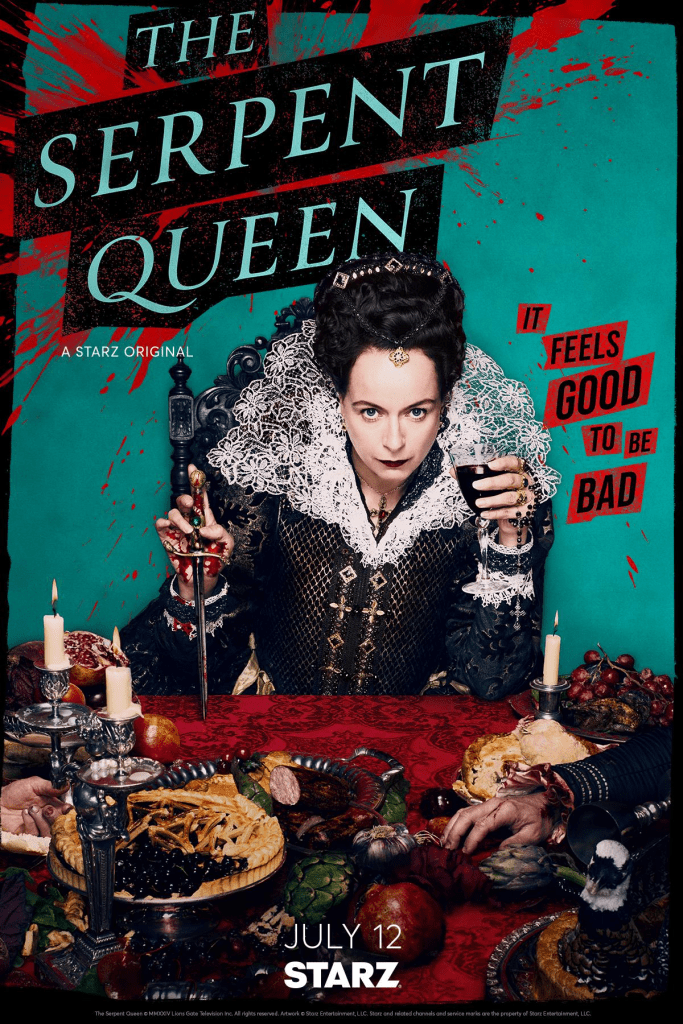
During my conversation with Laura, we were quick to connect over The Serpent Queen, one of Laura’s favorite projects to have worked on. She served as script supervisor for thirteen episodes across the two seasons the show ran. She worked closely with the creator, Justin Haythe, and helped build a fantastic series that has led to talks of a potential spin-off. Laura gave me some inside knowledge about tackling the set of the main palace, Chateau de Chambord. During production, Chambord was comprised of three castles: Château de Chambord in the Loire Valley, Château de Chenonceau in Chenonceaux, and Château de Villandry. Maintaining consistency at these locations was challenging, particularly because they are tourism hotspots, feature historic or rustic buildings, and are not always accessible to filming crews. Along with this, she has to keep track of which scenes are being shot for the day, as the entire series will be shot together, rather than episode by episode. When there are time windows at certain locations, it is imperative for script supervisors to keep on top of their duties so a reshoot is never needed due to continuity concerns.
Laura also pinpoints that there is no significant difference in her responsibilities when part of the production for a period piece and a modern story. She will sometimes do more research for historical-based dramas to learn about actions, props, settings, and other elements. These can fuel continuity elements, such as gestures during a specific time period, ensure appropriate props are correctly placed, and appropriate dialogue is repeated for multiple takes. She alluded to this when detailing her time as part of the crew for the series The New Look. She stated that the lead actress was incredibly knowledgeable about Coco Chanel, and this affected the components during shooting. Laura would have to note those changes and remember the alterations to ensure consistency in every take. She also mentioned one of the main differences between the production of a period piece and a modern piece is the use of VFX. A VFX supervisor is typically on set each day to advise the director about special effects and their limitation. Laura mentioned a VFX crew member was usually on site during The Serpent Queen’s production.
While I conversed with Laura, learning about the responsibilities of a script supervisor and specifically her tasks on large-scale productions, I got to hear about some of her personal favorites and hobbies related to film. Laura has enjoyed movies all her life, taking an interest in the Matrix and Fight Club from an early age. Nowadays, she confessed she doesn’t have a top favorite movie, but rather enjoys new releases, and likes to rewatch some classics. Along with this, Ms. Petoin goes to the cinema three times a week, keeping up with the latest films and TV shows, but sometimes indulges in older ones.
Her esteemed career and heartwarming personality made it an absolute treat to speak with her, and prove that she knows what it takes to be an accomplished professional in the entertainment industry. Her work in French and international motion pictures has given her a well-accomplished career, and she still has a fruitful path ahead. Hopefully, she will be on your next project, and you can rest easy knowing she will outperform all expectations.
Laura recently completed working on Vanished, a TV mini-series created by David Hilton and Preston Thompson, set for release in the U.S. in 2026.


 ScreenWorks
Leave a comment