
by Gina Batzia
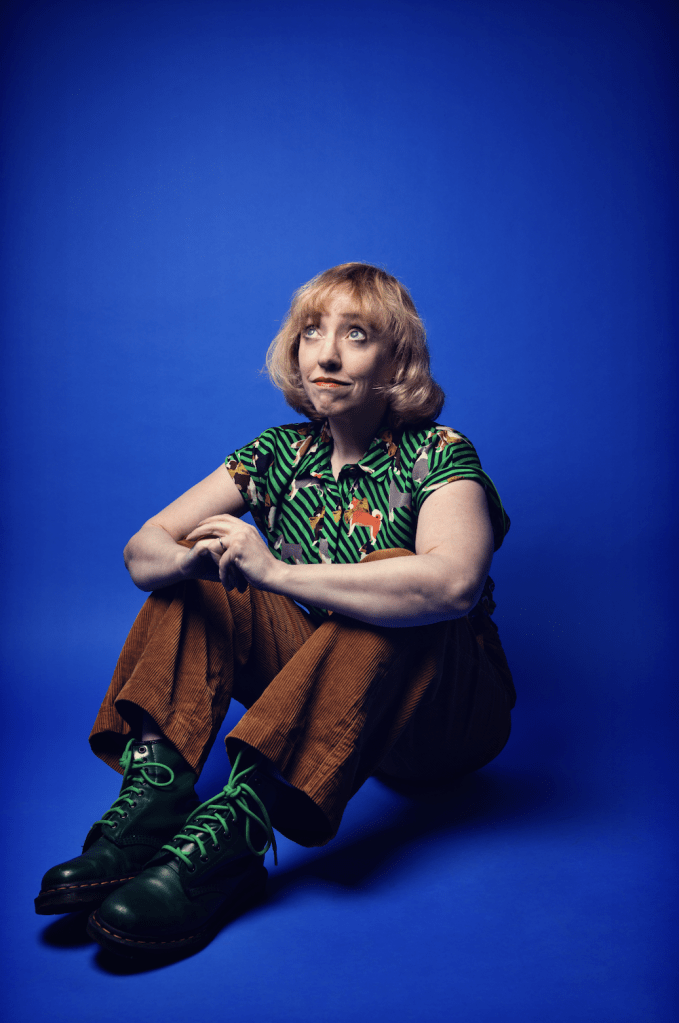
Gemma Arrowsmith is a comedy writer, actor and script editor. She has written for shows such as Tracey Ullman’s Show, Tracey Breaks the News, The Amazing World of Gumball and Horrible Histories. Her audio work includes writing for Doctor Who series by Big Finish Productions and working as a script editor on the BBC Radio 4 sketch show Newsjack. She also creates her own shows for radio, stage and various online platforms.
What made you want to start writing?
I’ve loved comedy since I was about 10, when I first saw Fawlty Towers and Red Dwarf and things like that. And, when you really love something like that, you just try and emulate it, don’t you? So, when I was about 10, I was basically writing a spoof Red Dwarf. Then I got interested in acting. I went to drama school. But even when I was at drama school, I would always write things to perform as well. If we had a class where you could just do anything, I would just perform something. I would always write a little comedy monologue for myself to do, heavily influenced by The League of Gentlemen at that point. After I graduated drama school, I got into comedy. I went to the Canal Cafe to do News Review, which is a topical sketch show, and I started writing some sketches there, teamed up with a fellow comedian called Steve Mould, and we had a double act and took shows to Edinburgh, which we wrote. So it was always sort of just been there, acting and writing, kind of complementing one another throughout my career.
You’ve developed your own work and have written for yourself, but you’ve also written for other shows and performers. Do you find the two experiences different?
That’s a great question. They’re really different. I think writing for yourself and writing for a known voice, they’re two different skills. If you’re just writing a script and you’re the only person who needs to see that script ever, you can write in such a shorthand. When I used to run a little YouTube channel called Sketches in my Flat, which was just me doing sketches in my flat, the scripts for those weren’t properly formatted or anything. They were just scribbled in a notes app somewhere. And because no producer or any other actor or writer needed to understand the script, you can just shorthand things. So I would sometimes write a little note for myself saying, like, “do the face”, because I knew what that meant. Whereas, when you’re writing for a show, you’re writing for different talent. You’re having to appreciate what on-screen talent can do and write for those strengths. And you’re having to write to a budget. You’re having to write for, “We definitely can’t afford this location.” So can you set it here? “We can’t afford that number of people.” So can you amalgamate these two characters? You’re having to incorporate all these sort of extra – I was going to say limiting factors, but I don’t want to feel like it’s limiting. It’s these other factors you need to consider. But, writing for a different voice, sometimes that’s what people are incredibly good at, rather than writing for their own voice. You’re told often, “Aren’t you ought to find your own voice as a writer? You must find your own voice”. And that is true. But I think being able to write for an existing voice is really valuable as well. It’s just a different string to your bow, really. They’re just very different processes and I love both of them.
Would you say your process changes when you have to write something that’s more topical or satirical as opposed to something more character-based?
I think so. First of all, I’m gonna do my customary differentiating between topical and satirical because I don’t think they’re exactly the same. They often overlap, but you can be satirical without being topical. You can be topical without being satirical. Often things are both. For example, I used to script edit on a Radio 4 Extra show called Newsjack, which was an open door sketch show that was topical. And sometimes the sketches that came in were satirical, sort of speaking truth to power. If you’re satirical, you’re speaking truth to power. It’s like the stuff that Armando Iannucci does, that Chris Morris does. Whereas topical just means a sketch about something that happened in the news that week. It doesn’t necessarily have to be satirical. It doesn’t have to have a great point that it’s making. And Newsjack was a topical show. Your jumping off point had to be something in the news that week. I love writing both topical and satirical things. I worked on Tracey Ullman’s Show for years, which was often a satirical show. When it came to Tracey Breaks the News, which was recorded in a completely different way, that was a topical show. That was recorded every week. With Tracey Ullman’s Show, it was recorded about six months in advance of the broadcast. So you just couldn’t be topical. It could be stuff that was in the zeitgeist, things that were generally happening in the world, but it couldn’t be anything that was specific to that week’s news. Whereas, when we moved on to Tracey Breaks the News, we would write on a Friday and a Monday. It would be recorded on the Tuesday and Wednesday, edited on the Thursday, and then it would go out on the Friday. That was the weekly cycle of it. On Tracey Breaks the News and, I believe, on other very topical shows, they would deliberately use shots where you wouldn’t see the mouth, so you couldn’t necessarily see the lips moving, so you could drop in lines last minute. If anything topical happened very last minute, you could re-record something and drop it in, which is clever, isn’t it? Very different process.
Since you mentioned script editing, I’d like to talk about that a little bit. How do you find the balance between improving on a script without making it your own thing?
That’s one of the key things of being a script editor, not to do a line one rewrite. I think, if you are an editor, you should go into the script with a scalpel. And I actually think you should change as little as possible. That should be your job, to maintain as much of the original intent of the writer as possible. Obviously, sometimes your producer might be saying, “I need to change this and this and this”. My job as a script editor is to keep the original intention and the original script of the writer as intact as possible while making those changes to keep the producer happy. I think doing a complete line one rewrite, which I have seen people do, that’s against the spirit of what it is to be a script editor. Then you’re just a writer, right? You’re just taking a writer’s idea and just completely making it your own. What I actually like doing is sort of script consultancy where your writer comes to you with a script that they would like notes on, and then you work with them. You probably – and I definitely have – received notes that are very brutal and sometimes they make you feel really depressed for writing the next draft. When I’m doing script consultancy, what I try and see my job as, is to make the writer excited and enthused to write their next draft. I want the writers I work with to go away thinking, “Oh, brilliant. Yeah, these are some great ideas. I can’t wait to write my next draft”. That’s to do with how you deliver the notes. I once had a note that just said “no”. And what do you do with that? That’s not a well-delivered note because I can’t action that. You need a bit more than that. I enjoy very much when people get in touch with me, often with their sitcom scripts, and I get to work on it with them because it’s also my way of enjoying a sitcom in this era where there aren’t many of them.
Speaking of sitcoms, how much would you say is about the premise of a sitcom and how much is it just whether it’s funny or not?
That’s interesting. A lot of the wisdom is that it’s all about the characters. That if you don’t have the characters down, the situation of the sitcom can’t be rescued. I think that’s in almost every brief that goes out from various channels; they always say you have to start from character. You have to have characters that are recognizable and say something about the world and, often in the UK, are to do with class. I’ve been told recently, if you’re pitching a sitcom, put your character breakdowns first, before your episode outlines. Because the characters are what it’s all about. You can talk about the premise as long as you want, but who is actually populating the screen? Who are these characters that you want us to fall in love with? The most important thing in a sitcom is the characters and how they interact with one another. If you’re talking about Dad’s Army, the thing that makes Dad’s Army brilliant is that ensemble cast of characters, right? It’s this uptight Captain Mainwaring, who’s sort of lower middle class, but aspires to be more middle class than he is. Maybe you’ve then got his sergeant, Sergeant Wilson, who is this sort of upper class who drifts through life with no problems. Brilliant friction between those two characters. That’s what the show is really about. Rather than, “Oh, it’s the Home Guard during the war”. Sure it is, but you could take those characters and put them anywhere in any situation. It’s the characters that drive that sitcom.
Do you think writing sketches has helped you write more long-form scripts? Because I believe they’re more connected than people often realize.
I think that’s completely right. Sketch writing is a great sandbox in which to learn the basics of writing. How to set something up, how to pay it off, how to escalate it in the middle, your beginning, middle and end. How, if you want to pay something off, you need to seed it earlier in order for it to be satisfying. All of these very basic writing building blocks you learn in sketch comedy and then take on into your drama writing, your sitcom writing, your more narrative writing. It’s not a real surprise to me that a lot of our best sitcom writers, drama writers, started in sketch comedy. From Jennifer Saunders to John Cleese to Jordan Peele. I’ve certainly seen it a lot when I teach classes in sketch writing and the people who attend my sketch classes then submit sitcoms to competitions and write their own hour-long shows, more longer-form things. You often used to see it in Edinburgh with the sketch groups. They go a few years doing a regular sketch show and then you’d start to see them doing a show with a bit more of a narrative to it. The Penny Dreadfuls did that, and many other sketch groups as well. It’s just a lateral progression that you do these sketches and then there’s just a sort of desire to tell a longer story. You see it in The League of Gentlemen as well, in their progression from a live show – they were at the Canal Cafe, they took it to Edinburgh, they then had their radio show and then their TV show. And, in the third series of the TV show, we start to see these longer narratives all weaving together. And then obviously you got Reece and Steve go on to do Psychoville and Inside No. 9. So I think it’s a natural progression.
I also wanted to talk a bit about writing for audio, and especially comedy for audio. Do you find it more freeing since you’re not really restricted by what you can see?
I love that you say that it’s freeing rather than restrictive because a lot of people would say, when you haven’t got the visuals, that’s a restraint on you, that’s something that’s blocking you. But I love the way you ask, the fact that you say, “oh, do you find that really freeing?” Because I think you’re completely right. When you don’t have the constraint of “we actually have to make this real on a screen”, that is incredibly freeing. It’s why often you’ll find that your biggest ideas will be on radio. That’s where you can do a show set on a pirate ship or on a spaceship or in the Wild West. And you don’t have to pay for a Wild West set and you don’t have to pay for a spaceship set. You just conjure it up through sounds. It’s a natural place where you can do those huge ideas. It’s not a surprise that The Hitchhiker’s Guide to the Galaxy works best on radio, right? Because you can conjure way better visuals in your head than you ever could on the screen – the small screen or the big screen. The comedy writer-performer Joyce Grenfell used to say she preferred the radio to television because the pictures are so much better on the radio. Which is a lovely way of putting it, isn’t it? When I’m teaching writing for radio, one of the things that we always find ourselves saying is that it’s a really visual medium. That seems like a ridiculous thing to say because you’re talking about radio or podcasting, but it is, it’s just you’re conjuring those visuals in the listeners’ minds. And one of the things I get the students to do is to write a sketch that could only work on the radio, either because it would just be so expensive to do on TV or it would be logistically impossible. On the radio, you can have a sketch that is between two animals or two objects or even two concepts. You can have two horses in a paddock having a conversation. You can have the sofa arguing with the chair over who’s best. Someone wrote a sketch where it was “my depression arguing with my anxiety”. Which is a fun idea, isn’t it? Of course you could find a way of doing that visually. But isn’t radio just the best medium to do that sketch in? It just lends itself to it perfectly. I think it’s a very exciting medium to write. I’m not going to say podcasting is completely egalitarian, because you have got corporations and big money moving into podcasting, which has meant that the playing field isn’t completely level in podcasting. But I think the exciting thing about podcasting – I think it was Deborah Frances-White of The Guilty Feminist podcast who said that podcasts are radio programs that no one stops you making. There is a certain sort of leveling of the playing fields when it comes to podcasting that you can – with a decent-ish mic and a good idea and some good performers and a decent editor and things like that – you can put together something of pretty decent quality and get it out there. Of course, if you want to advertise it, that costs money. I’m not saying it’s completely free. But it’s cheaper than trying to put together a half-hour sketch show that you film. It’s a wonderful medium, writing for audio – and I think podcasting is an extension of that – that is important to consider as well.
Do you think, for comedy, it helps to have experience on stage and get that immediate reaction of what’s working and what isn’t?
That’s interesting. I know lots of people who have come up through online platforms – YouTube, and now Instagram and TikTok, and don’t necessarily have that kind of live basis and they’re doing really well. Do I think it’s necessary? I think it’s brilliant doing live stuff. That’s how I started. As I said, I was at the Canal Cafe Theatre doing News Review and then I did live shows. I did character stuff on my own. I ran a monthly character comedy night with Tom Nelstrop and Tom Golding at Lowdown at the Albany called Comedy Sleepover for a few years and that was brilliant. And going to the Edinburgh Fringe for years, it’s definitely a brilliant way to cut your teeth and to, like you say, get that immediate feedback from an audience. There’s no better way of knowing whether a joke works than just doing it live in a room and hearing the reaction immediately. Absolutely. But do I think it’s 100% necessary? Maybe not anymore. Because now we’ve got this proliferation of online platforms where you can make your own work and get it out there, and these brilliant content creators that make fantastic stuff and they maybe don’t ever do a live show and maybe that’s okay. I think it’s certainly a brilliant experience and there’s nothing like going to a live show, is there? There’s nothing like being in the room where that is literally happening. And if you’re a person starting out and you’re writing and you want to get that immediate feedback on whether that writing is working, saying it out loud in front of people, there’s no quicker way to find out whether something’s working. But there are definitely other avenues as well.
Is there something you’re working on that you would like to talk about?
There’s a few things I’ve been working on. This coming out at the moment is, me and Tom Nelstrop and Susan Harrison, the three of us are working on a thing called Leyline High Rewind. It is a spoof rewatch podcast of a long-running children’s show called Leyline High – which never really existed – but we’re rewatching episodes of this show and talking about our favorite episodes. It’s part improvised, part written, and it’s available wherever you get your podcasts. Leyline High Rewind. Check it out. It’s a very fun show to work on.
And, finally, there’s currently a lot of discussion about AI and what that would mean for writers and the industry in general. Do you have any thoughts on that?
Interesting. As I say, I teach these classes in sketch writing, and I have these little guidelines that I send out to students on how they can get the most out of the classes. And part of that is making sure you’ve got a decent enough Internet speed because they happen over Zoom. But I’ve added a little thing about AI and it’s basically saying please don’t submit things written by AI to this class because I’m not here to teach an AI how to write sketch comedy. I’m here to teach you. And so I don’t want to hear from an AI, I don’t want to hear from ChatGPT, I want to hear from you. I think it just feels like it’s outsourcing the good stuff. This is the fun bit, isn’t it? The writing. Comedy is the bit that we enjoy. That’s why we’re here. That’s what I love doing. I’m not going to let a machine do it for me. I’ll let a machine wash my clothes because that’s boring. But this, I like doing this. Why would I let a machine do it for me? I think it’s a really interesting time to be working. I think AI has lots of fantastic applications, particularly in the medical field, but I think generative AI is outsourcing the fun bit. At the moment, I can’t wrap my head around why. Obviously for money. It’s about going “what’s the cheapest way I can get a product?” But, as I get older, the more I realize that it’s about the journey, not the destination, really. It’s about the process of creating the art rather than necessarily the end product. So when you come to do my class, you’re doing my class not to just have some sketches finished at the end. It’s about writing something yourself. Going through that process of going, “oh, no, that line’s not quite right yet. How can I make it better?” “Are these characters actually both doing the same thing? Let’s amalgamate them.” “What’s the funniest way we can do this?” That is what it’s all about. Just having a finished sketch isn’t what it’s all about. It’s about the journey. So outsourcing that journey to a language model, I can’t wrap my head around it at the moment.

 ScreenWorks
Leave a comment